We build technology and the tools to move it forward.
Computational engineering software, physical technology, and intelligent systems—built with aerospace engineering experience, manufacturing knowledge, and modern software development.
A difficult idea needs more than analysis. It needs tools to explore designs, ways to test results, and a path to implementation. We work across those boundaries—developing technology, building purpose-built software, and organizing the work needed to carry it forward.
01 / Technology
Technology we develop.
Original physical technology and focused intelligence built around specific problems.
Thermal engineeringPhysical technology
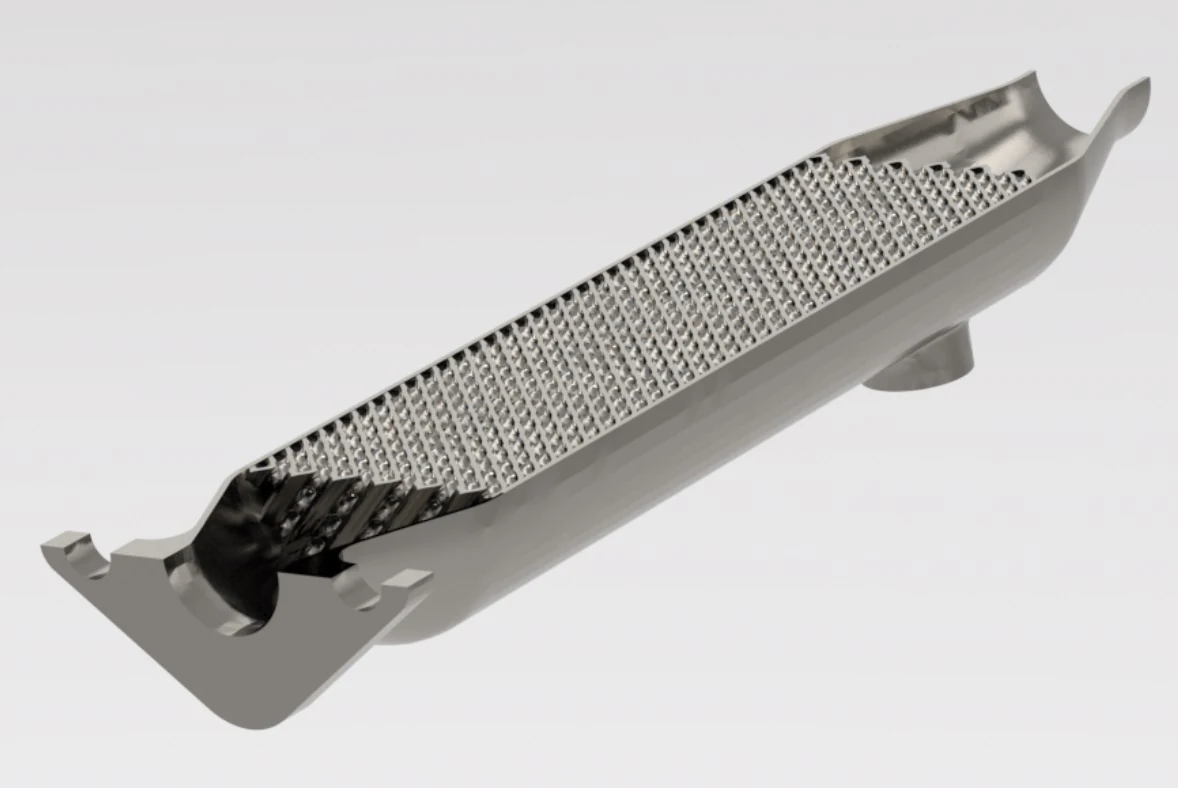
Sectional rendering of a MoBi-Core heat exchanger.
MoBi-Core heat exchangers
A class of additively manufactured heat exchangers built around monolithic, bicontinuous core geometries. Complex, self-supporting structures create two independent flow labyrinths that are hydraulically isolated from one another, providing high surface area per unit volume and exceptional heat transfer performance. Their design brings geometry, thermal-fluid analysis, and manufacturing constraints into one engineering problem.
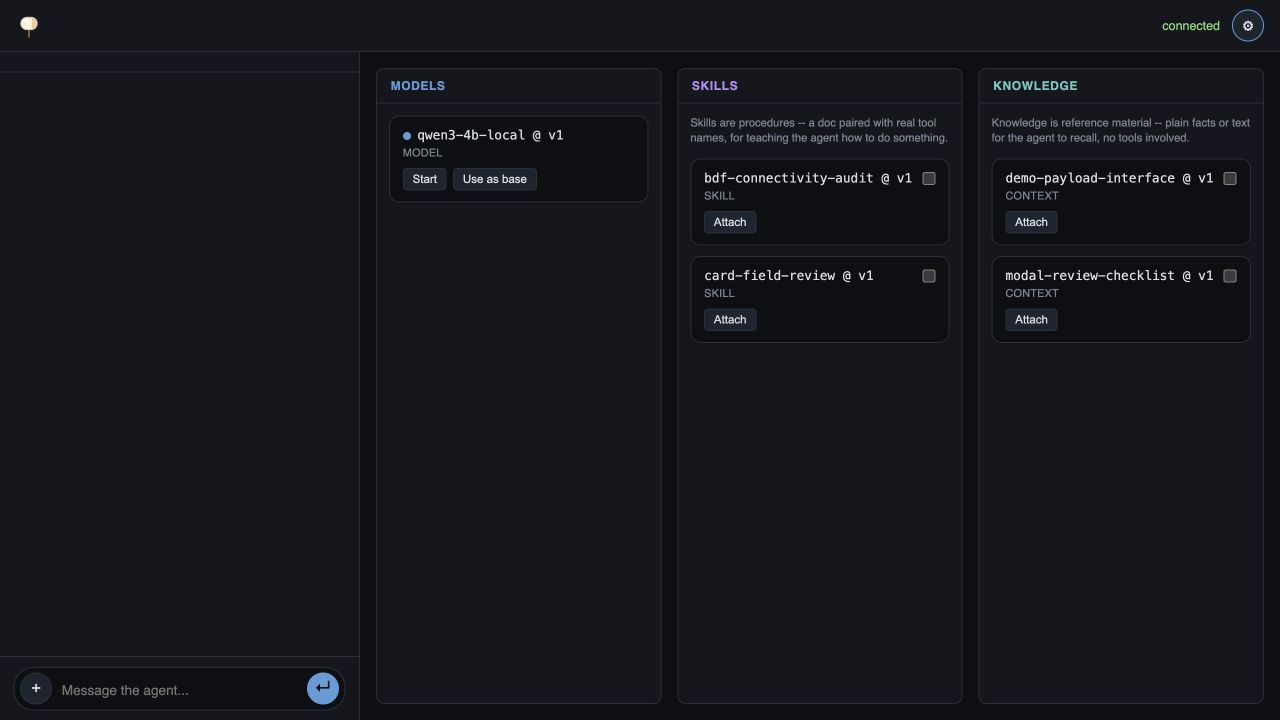
SLM means Specialized Language Model. The SLM Gym (pronounced “Slim Jim”) develops small models for defined jobs with task-specific skills and knowledge that can run locally.
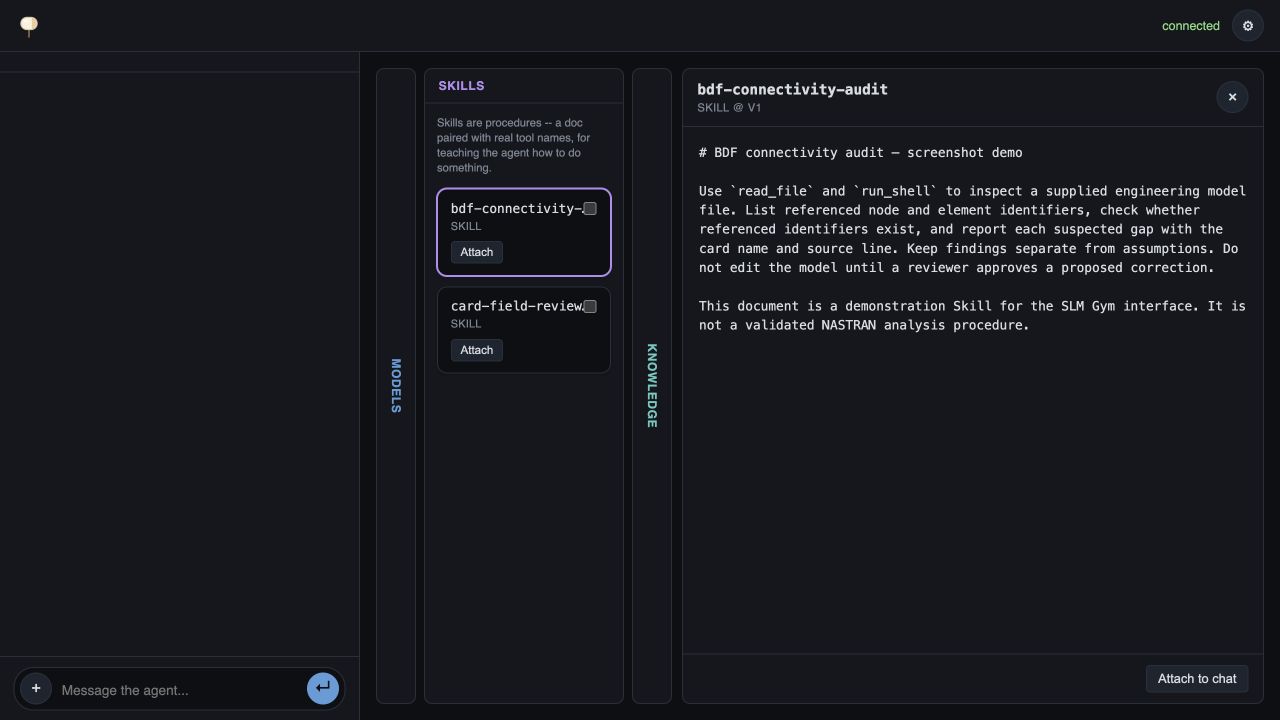
Organize a base model, task procedures, and reference knowledge in one workspace. This example shows how an engineering review procedure can be captured as a reusable Skill. The framework is built for focused context, local operation, and control over data and costs.
Illustrative demo content.
Models, Skills, and Knowledge in one workspace. Swipe to inspect each panel. Select the image to enlarge.Sample Skill procedure. Select the image to enlarge.
SLM Gym v0.5.0 interface preview. Example engineering content is synthetic; the images do not show completed training, a NASTRAN audit, or a validated model response.
02 / Organizations
Organizations we’ve built.
Research, manufacturing, and energy work that shaped how we build today. Each began with a practical engineering question and grew into the people, tools, and processes needed to pursue it. Together, they give us firsthand experience carrying ideas from analysis into operations.
Research & development
MoBi-Group
MoBi-Group advances research into MoBi-Core heat exchangers. We are developing a collaborative research model in which researchers use MoBi-Form to prepare studies, geometries, meshes, and build files, then contribute results that help map the design space.
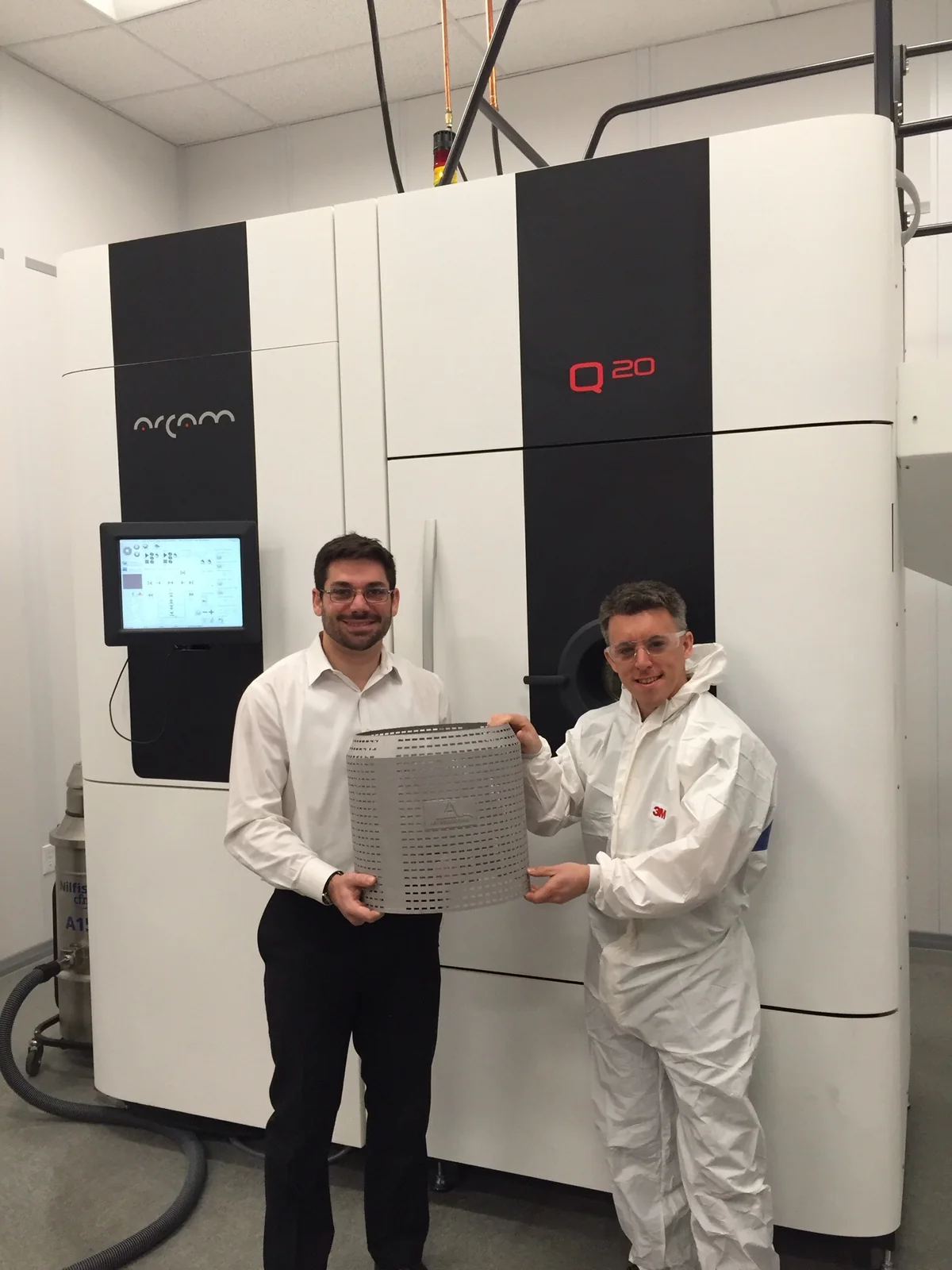
Our additive manufacturing engineering and service bureau combined design and analysis with hands-on operation of titanium printers. We also built Doug, a working machine vision prototype on a desktop FDM printer that identified defects and sent repair commands in real time.
Our first business together began with visits to operating farm digesters and farm energy consulting. We developed a continuous-flow, temperature-phased anaerobic digester for converting organic material to methane. A proposed dairy-farm pilot did not proceed because the economics were not right at the time. We have since revised the design to incorporate MoBi-Core; that revision has not been field validated.
03 / Featured software
MoBi-Form
Purpose-built software for a demanding class of heat exchangers.
MoBi-Core design connects requirements, geometry, fluid and solid domains, meshing, analysis, and additive manufacturing preparation. MoBi-Form is being developed specifically for that work, bringing the design steps into a connected workflow.
Define the geometry
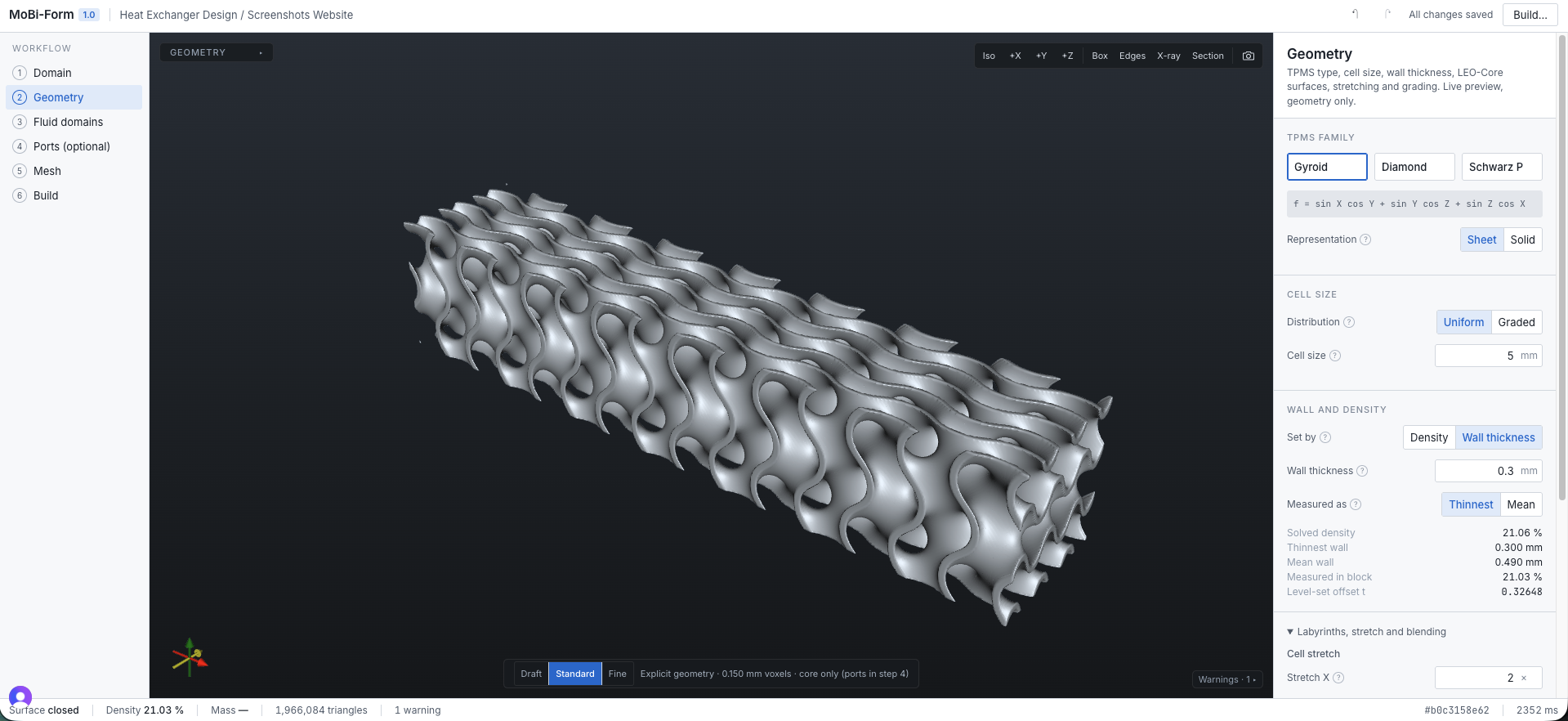
Different Triply Periodic Minimal Surface (TPMS) topologies can be applied, with control over unit cell size, orientation, phase, wall thickness, volume fraction, unit cell stretching, and blending between TPMS topologies.
Figure 1 · Geometry: parametric Gyroid core.
Separate the fluid domains
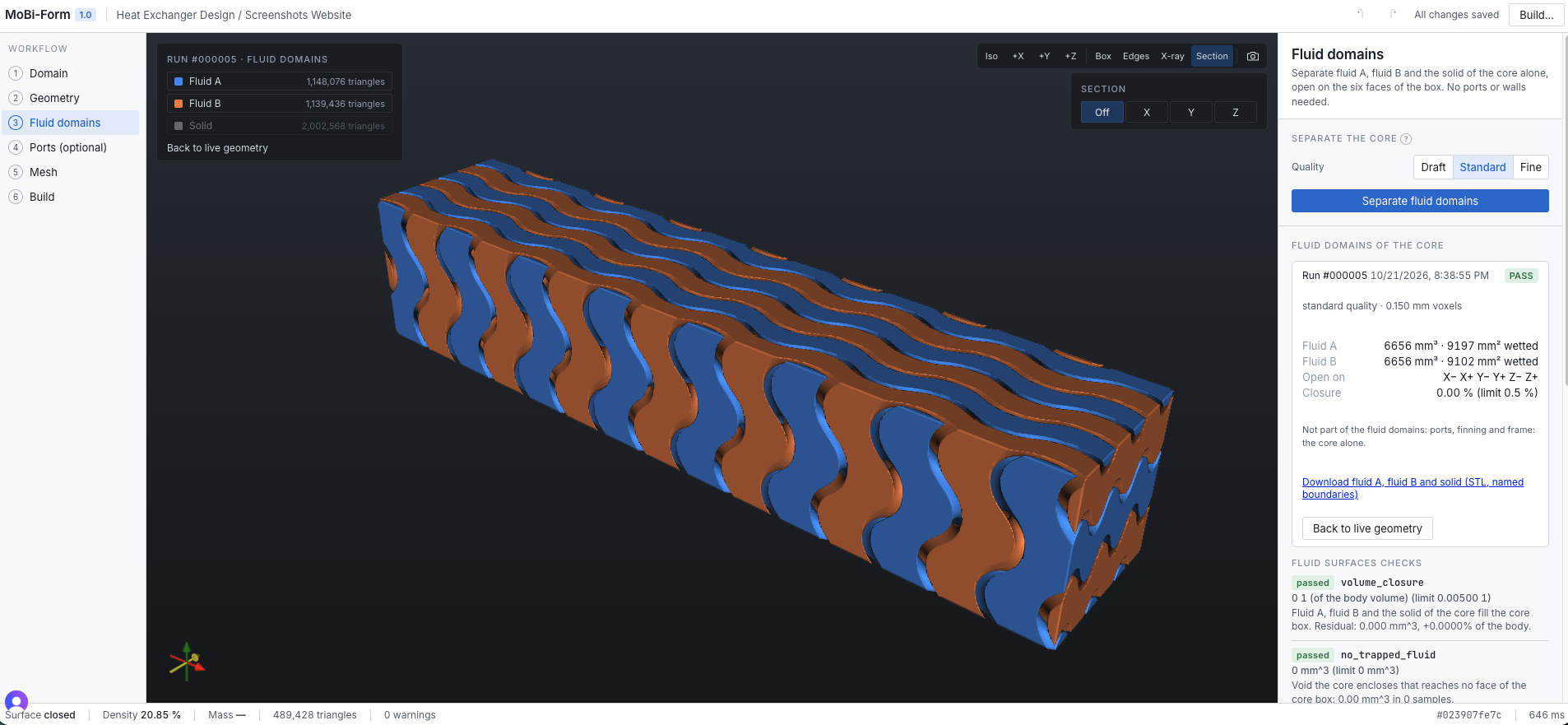
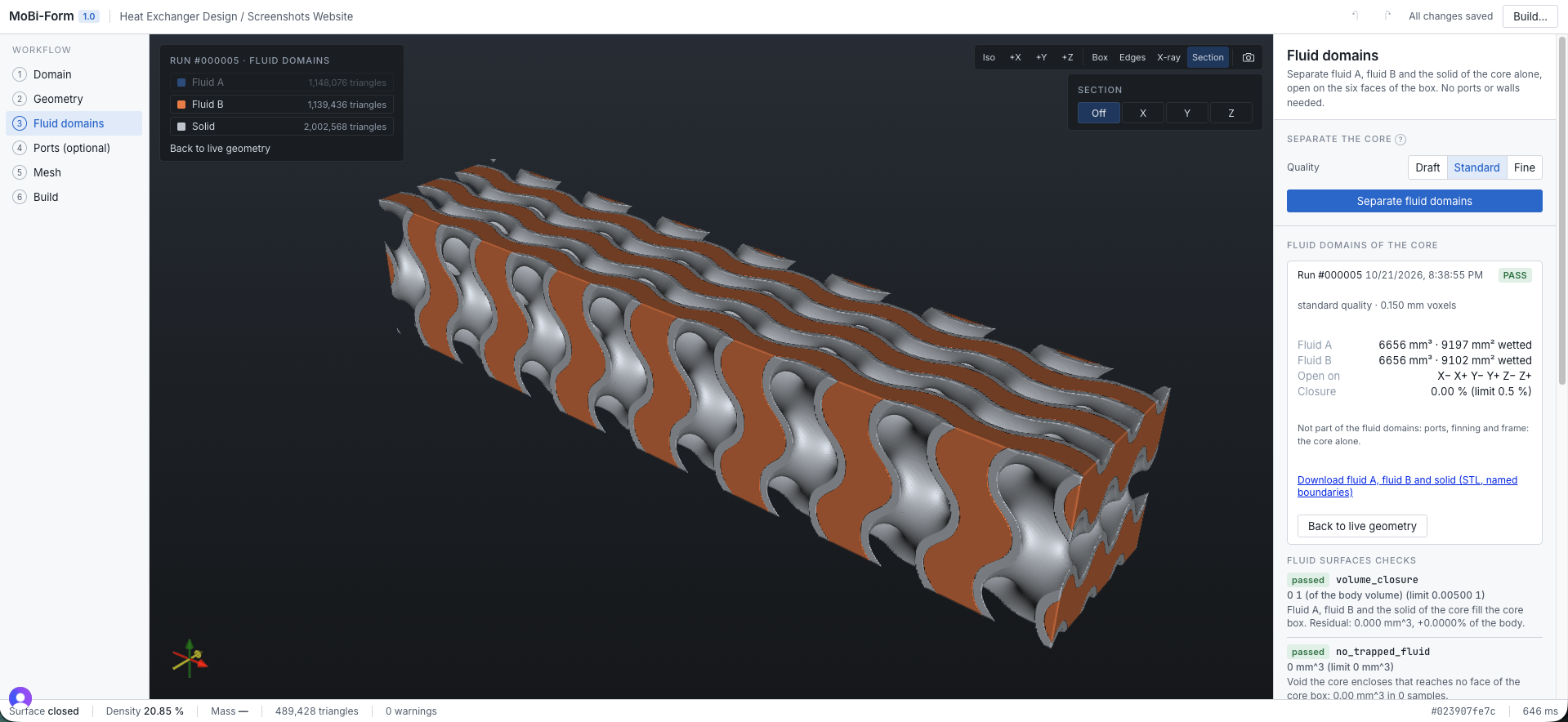
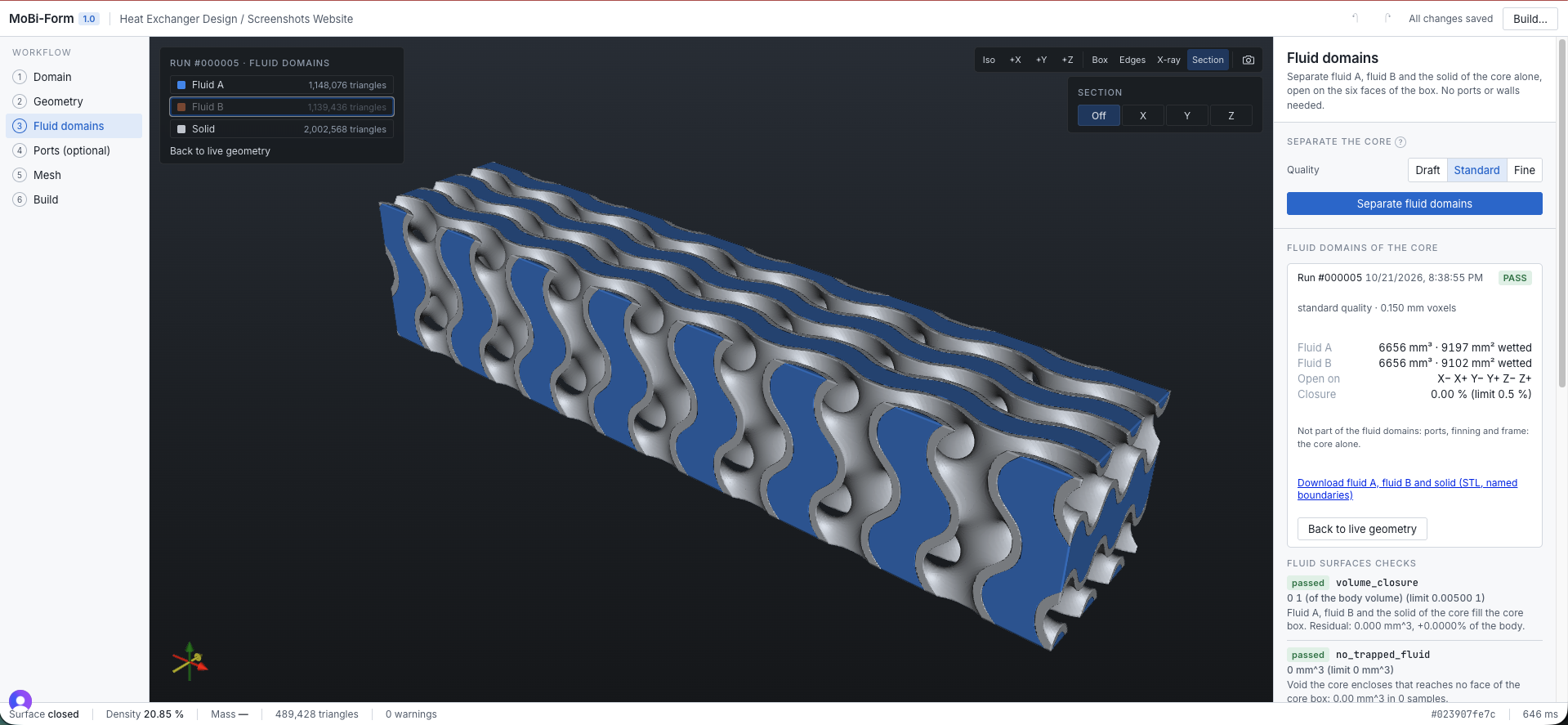
MoBi-Form separates the fluid domains created by the core geometry. Hot and cold labyrinths can be turned on and off and inspected.
Figure 2 · Separated fluid domains: both labyrinths, hot labyrinth, and cold labyrinth.
Complete the heat exchanger
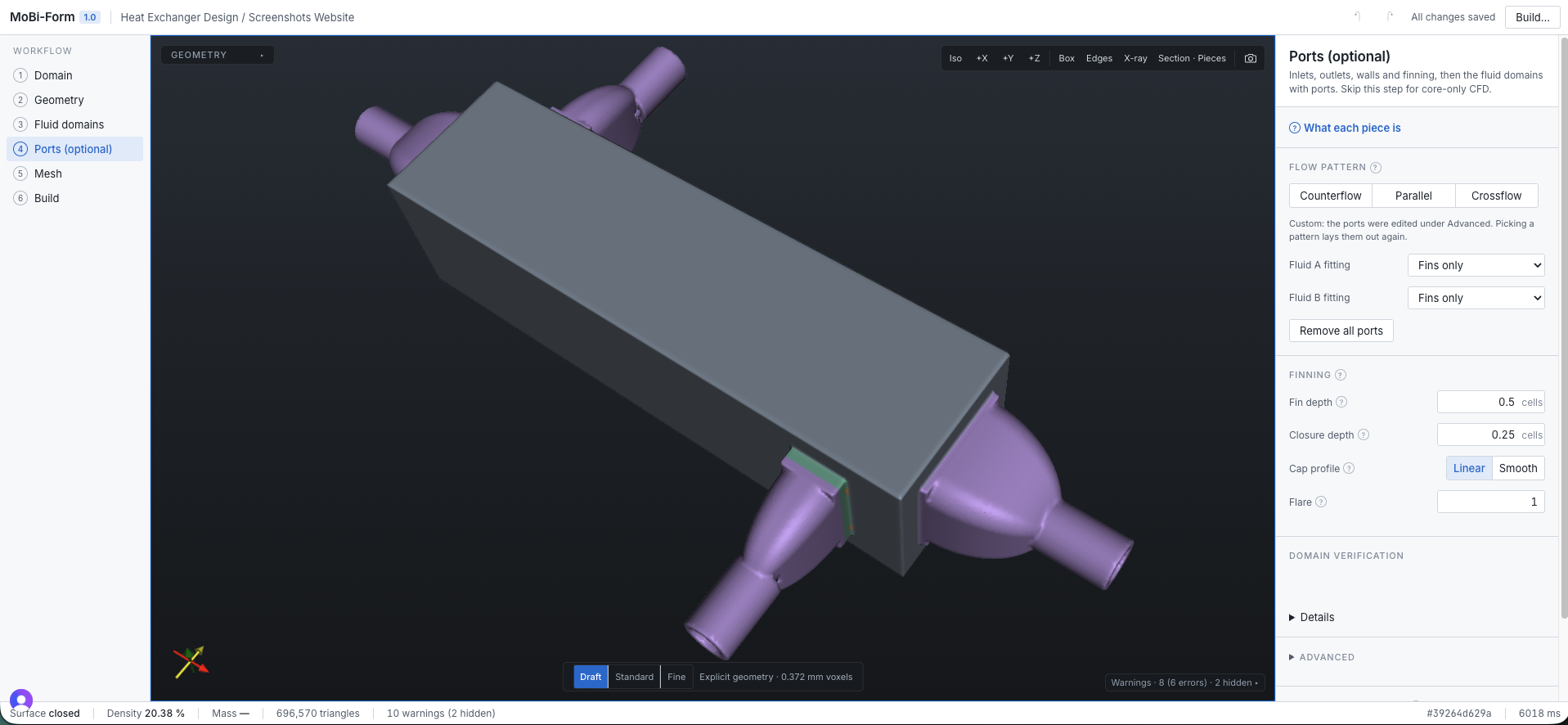
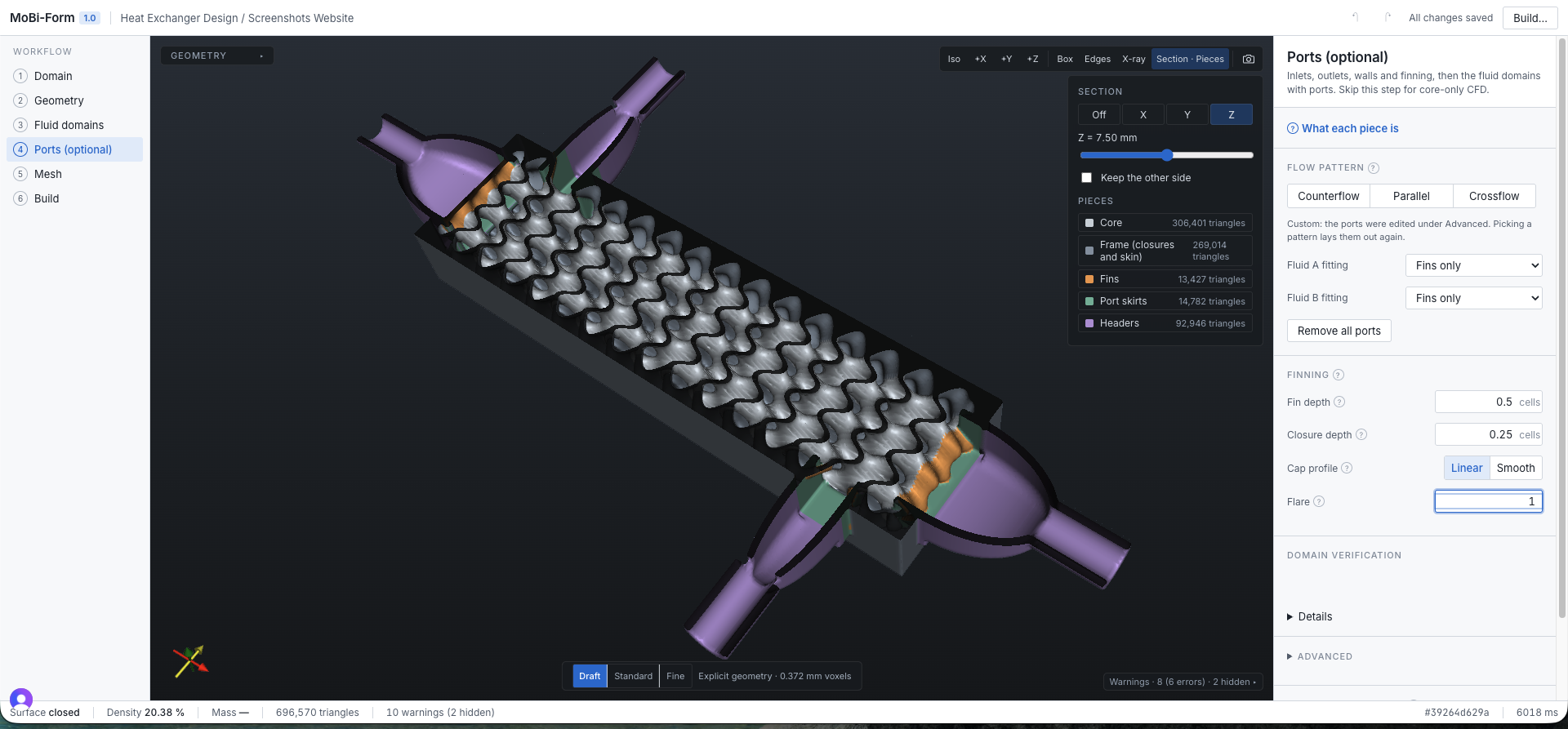
MoBi-Form automatically creates finning structure to selectively shunt off labyrinths for the appropriate port. MoBi-Form also allows for full control of port location on the core, variation in plenum type, and parametric control over the plenum and port geometries.
Heat exchanger assemblySectioned heat exchanger
Figure 3 · Heat exchanger assembly and sectioned view.
Mesh and export
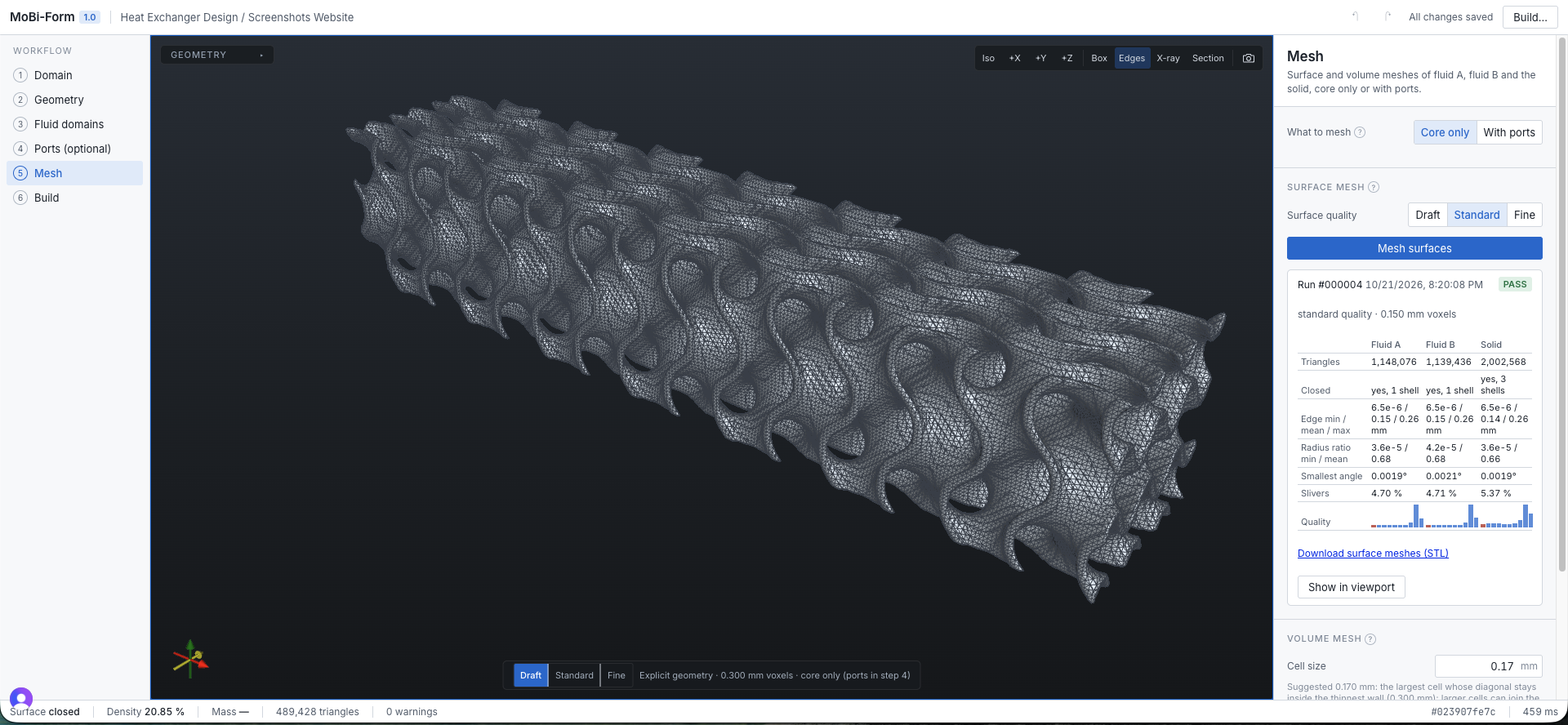
MoBi-Form creates surface meshes for finite element analysis, volume meshes of the fluid domains for computational fluid dynamics, and generates a 3MF file for 3D printing.
Figure 4 · Surface mesh.
Current capabilities
MoBi-Form supports reproducible research and the development of a consistent dataset across the MoBi-Core design space. For a custom heat exchanger, it can define a core, separate the fluid domains, and add walls, fittings, structure, ports, and plenums. The resulting geometry can be meshed for thermal, structural, and fluid analysis.
Future direction
The goal is to use surrogate models to optimize designs against specified performance requirements. A more integrated workflow would reduce the number of separate tools needed to design, analyze, and manufacture this class of heat exchangers.
04 / Operational systems
Software for work we know firsthand.
We developed these tools to solve problems in our own operations, combining deterministic software with focused AI where interpretation helps. Each keeps the process, records, and decisions visible while an SLM can support a defined task. The same patterns can be adapted for other organizations.
Process management
Pipeline
Manages operational processes: jobs, decisions, handoffs, and follow-through. It gives a defined sequence to work that otherwise lives in scattered messages and memory. We use it to make ownership and next actions clear, while focused AI can help interpret incoming information within that sequence.
Live coordination
Clipboard
Coordinates the execution of events as people, tasks, and conditions change. It brings the current plan and the latest updates into one place so a team can respond without losing the thread. Its structured workflow keeps people in control as circumstances shift.
Records & learning
Logbook
Manages paperwork, records what happened, and carries lessons into the next run. It turns routine records into a usable history of work and decisions. Focused AI can help find relevant context, while the underlying records remain the source of truth.
05 / The people
Different disciplines. Shared work.
Joe Manzo ↗ and Brian Vetere ↗ met on the crew team at Embry-Riddle, worked together at Orbital, and went on to build businesses together. Both are hands-on builders and advanced AI users.
Joe brings mechanical design, thermal-fluid analysis, manufacturing, and venture development. Brian brings electronics, controls, software, and systems engineering, applying AI to hardware development. Together, they connect physical engineering with the software and intelligent tools needed to build and operate it.